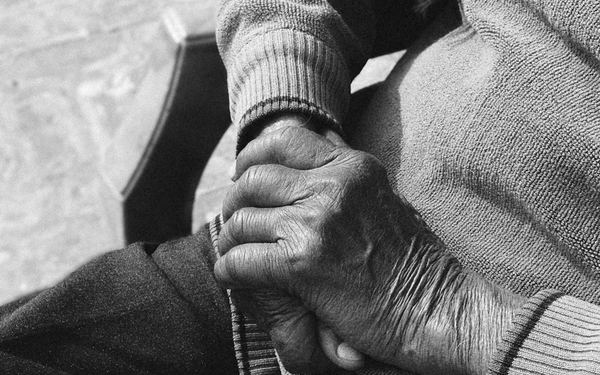
When you live with someone, your eyes adjust to them. The shuffle, the slower turn at the kitchen island, the way they reach for the counter on the way to the bathroom — those become wallpaper. You stop seeing it. Not because you don’t care. Because your brain stops registering what it sees every day.
Nursing school re-teaches you how to look.
I’m in the LVN-to-RN track right now, and the most useful thing I’ve picked up isn’t a procedure or a drug name. It’s a way of walking into a room. We call it a focused assessment, but really it’s a discipline of noticing — five things in the first sixty seconds. And once you learn to do it on a parent, you stop being surprised by ER visits.
Here’s what we’re trained to scan, translated into family language.
How they’re breathing — before they speak. A relaxed older adult breathes about 12–16 times a minute, mouth closed, no shoulder lift. If your dad’s chest is rising up toward his collarbones, or his nostrils are flaring on the inhale, or he pauses mid-sentence to catch air — that’s not “just getting older.” That’s a tell. It can mean fluid building in the lungs, a med dose that’s wrong, anemia creeping in, a UTI dressed up as fatigue. None of those wait politely.
The walk from the chair to the door. We call it gait. You’re not grading it like a doctor — you’re just looking for change. Wider stance than last month? A new lean? A hand that wants the wall now? Falls in older adults don’t usually announce themselves. They show up in the gait first, sometimes weeks before the floor does.
Skin elasticity — checked in the right place. The classic dehydration check is to pinch a fold of skin and see if it snaps back. Just don’t do it on the back of the hand. Older skin loses elasticity there normally, so the back of the hand gives false positives every time. The reliable spot in a senior is the upper chest, just below the collarbone, or the inner forearm. Pinch a small fold there, let go — it should flatten almost immediately. If it stands up like a tent for a second or two, that’s dehydration. And dehydration in a senior is not a glass-of-water problem. It’s a confusion, fall, and kidney problem. We catch it at the bedside before the labs do.
The tempo of the conversation. This is the one families miss the hardest because it feels rude to clock. But the speed at which someone finds a word, finishes a thought, gets a joke — that’s a neurological vital sign. A new pause that wasn’t there in March is information. It doesn’t always mean dementia. It can mean a new medication, poor sleep, a small stroke, depression. But it means something, and the earlier it’s named, the more options exist.
The smell of the room. I almost didn’t include this because it sounds undignified. But it’s clinical. A sweet-fruity smell can be uncontrolled diabetes. Ammonia means a kidney problem. A musty smell where someone is sitting most of the day can mean skin breakdown nobody’s seen yet. Trained noses catch what families have stopped noticing because they live in it.
Here’s the part I want every West LA family to hear.
You are not supposed to know how to do this. Nobody teaches you. There is no class your parents took on aging that gave you the playbook, and there is no chapter in raising children that quietly prepared you for the reverse direction. Most families I talk to feel guilty for not noticing sooner — and that guilt is misplaced. The eyes that miss the early signs are loving eyes. They’ve just been looking too long.
This is a big part of why I built CarePali. Private, non-medical home care doesn’t replace your eyes — it adds a second set, trained, calm, and unfamiliar enough to see freshly. A CarePali caregiver isn’t there to diagnose. We’re there to notice — and to flag, in plain language, the things that should make it onto your next conversation with the doctor.
Most ER visits in older adults aren’t surprises if someone was looking. The shift in breathing, the new lean, the skin that won’t spring back — those are usually whispering for days, sometimes weeks, before the crisis. The job is to put someone in the room who can hear the whisper.
If you want a single thing to do this week: walk into your parent’s living room and pretend it’s the first time you’ve ever been there. Sit for two minutes. Listen for the breath. Watch the walk. Look at the hands. Smell the air. You don’t need a stethoscope. You just need permission to look new.
That’s what nursing school is teaching me. It’s also what we bring into every CarePali home.
CarePali serves families in Santa Monica, Brentwood, Pacific Palisades, Malibu, Bel Air, and coastal Ventura. If you’d like a calm second set of eyes in your parent’s home, reach@carepali.com.