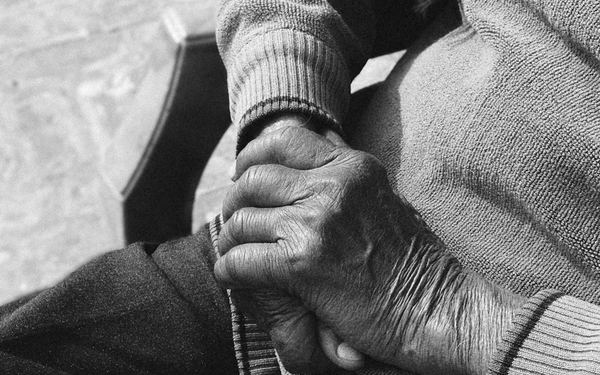
You come by on a Sunday and the bed is made. Not made this morning — made for a while. The pillow still has the shape it had the last time anybody slept on it. Your father is where he has been every time you have stopped in for the last two months: in the recliner, in front of the television, with a blanket over his knees.
You ask about it. He says the chair is just more comfortable. He says he falls asleep watching the news and doesn't see the point in getting up. He says the mattress is too soft. He says he sleeps fine.
All of that may be true. But a parent who has quietly stopped sleeping lying down has told you something, and it is worth finding out what.
Lying flat is a stress test nobody scheduled
When you lie down, fluid that spent the day pooling in your legs redistributes toward your chest. A healthy heart handles that shift without you ever noticing. A heart that is struggling does not, and the first symptom is usually a simple, physical fact: it is easier to breathe sitting up.
Cardiologists have names for this. Orthopnea is breathlessness when lying flat, relieved by propping up. Paroxysmal nocturnal dyspnea is waking up an hour or two into sleep, suddenly short of breath, needing to sit on the edge of the bed or stand by a window. Both are listed among the classic warning signs of heart failure by the American Heart Association, and both have a habit of arriving so gradually that the person living with them never reports them. They just add a pillow. Then another. Then they move to the chair.
Heart failure is not rare and it is not a death sentence. More than six million American adults are living with it, and its prevalence climbs steeply after 65. It is also one of the most common reasons older adults end up admitted to a hospital — often after weeks of symptoms that looked, from the outside, like a preference for a comfortable chair.
The chair is not always the heart
It would be irresponsible to tell you that a recliner means a cardiac problem. It often doesn't. The same behavior shows up for reasons that have nothing to do with the heart:
- Reflux. Lying flat lets stomach acid travel. Sleeping upright is the oldest workaround there is.
- Sleep apnea. Common in older adults, frequently undiagnosed, and often better in a semi-upright position.
- Pain. Spinal stenosis, hip arthritis, and shoulder problems can all make a flat mattress the worst surface in the house.
- Lung disease. COPD and long-standing asthma follow a similar logic — upright is easier.
- Getting out of the bed. This is the one families miss most. Sometimes the chair is not about sleeping. It is about standing up. A recliner with arms and a forward tilt is far easier to rise from than a low, soft mattress. If your parent moved to the chair because the bed became a trap, you are looking at a strength and mobility problem — and its own falling risk — not a breathing one.
Five different causes, five completely different fixes. Which is exactly why the answer is not to guess, and not to move the recliner back into the bedroom and call it solved.
What to look for before you call anyone
Clinicians can do far more with specifics than with worry. Before the next appointment, spend a week collecting facts instead of impressions:
- Count the pillows. How many does he sleep on now, and how many did he sleep on last year? An increase is a data point.
- Ask about the middle of the night. Not "do you sleep okay" — ask whether he ever wakes up needing air, and what he does when it happens.
- Look at the ankles in the evening. Swelling that leaves a dent when you press it, socks leaving deep marks, shoes that fit in the morning and not at nine at night.
- Weigh him, same scale, same time each morning. Heart failure programs teach patients to report a gain of two to three pounds in a day, or about five pounds in a week, because that is fluid, not fat. The Heart Failure Society of America publishes plain-language guidance families can follow.
- Notice the stairs and the walk from the car. Breathlessness doing something he did easily six months ago matters more than breathlessness in general.
- Listen for a dry night cough that shows up after he lies down and eases when he sits up.
Then say it plainly to the doctor: "He stopped sleeping in his bed about two months ago. He is on three pillows. His ankles swell by dinner. He has gained four pounds this week." That sentence gets a different appointment than "I think Dad seems tired."
Nobody in the family is expected to diagnose anything. The job is to notice the change and refuse to let it be explained away — including by the person it is happening to.
Why the chair goes unmentioned for months
Because it doesn't feel like a symptom. It feels like a habit. Your father did not wake up one morning unable to lie down; he drifted there over six or eight weeks, one adjustment at a time, and each adjustment was small enough to seem reasonable. That is how most serious changes in an aging parent's health actually present — not as an event, but as a slow renegotiation with the house.
It also goes unmentioned because the people who would notice are not there at bedtime. Adult children visit in the afternoon. The chair looks like a chair at two in the afternoon. It only tells the truth at eleven at night and again at six in the morning.
Where daily help changes the picture
Most of what is on that list above is not medical work. It is attention — the same scale at the same hour, a look at the ankles before dinner, a note that the second pillow became a third. It is the kind of thing that gets done reliably when someone is in the home on a schedule, and gets done sporadically when it depends on a busy adult child remembering to ask.
CarePali provides non-medical, in-home daily-living care across the Westside of Los Angeles and coastal Ventura — help with mornings and evenings, bathing, meals, mobility, and the steady day-to-day observation that turns a vague worry into something a physician can act on. We do not diagnose and we do not treat. We notice, we write it down, and we make sure the family and the clinician hear about it while it is still small.
If getting out of bed is the real problem, that is workable too: bed height, a rail, physical therapy, and a person there at the hour it is hardest. See post-surgery and recovery care for how that support is usually structured, or our services for what daily care includes.
One conversation, this week
You do not need to take the recliner away. You need to ask a question he has probably never been asked: when did you stop sleeping in your bed, and what happens when you try? Then call his doctor with the answer.
The recliner is not the problem. It is the solution your father found, on his own, to a problem he has not named yet. Your job is to name it.
For plain-language background on heart failure symptoms, the National Heart, Lung, and Blood Institute and the Heart Failure Society of America both publish material written for families. Neither replaces a conversation with your parent's own clinician.
If you are trying to sort out what daily help would actually look like in your parent's home, we can walk you through it. Call (310) 818-3217, email reach@carepali.com, or start care here.