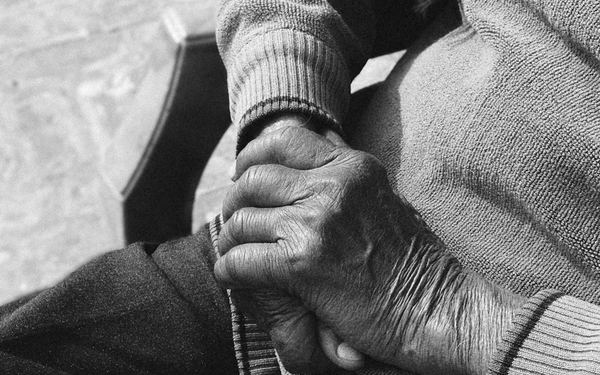
Your mother has had dogs for forty years. She is the person who cooked plain chicken for the one with the bad stomach, who kept the vet's number on the refrigerator door, who drove to three stores in the rain because the food he tolerated was out of stock.
You were there Sunday. The water bowl was empty — not licked clean, dry. The food bag was in the same corner, at the same level it was at last month. The leash had not moved off its hook.
You noticed. Something flickered. Then you let it go, because it is a dog bowl, and because the rest of the visit had bigger things in it.
It is not a dog bowl. Of every ordinary obligation in that house, the animal is the one she would defend longest — past her own meals, past her own doctor's appointments, past her own dignity. That is exactly why it matters when it slips.
Why pet care is the last thing to go
Daily tasks do not fail all at once. They fail in an order, and the order is informative.
The first things to go are the ones that are effortful and easily postponed — the shower, the stack of mail, the trip to the pharmacy. These are private. Nobody sees them fail, and your parent can explain each one away individually.
Pet care sits at the opposite end. It is overlearned — done the same way, at the same times, for decades, until it runs almost without conscious effort. It is also externally motivated in a way almost nothing else is: the dog asks. He stands by the door. He puts his head on her knee at five o'clock. A person can talk herself out of eating lunch far more easily than she can ignore an animal she loves staring at her.
So when the bowl stays empty, one of two things is usually true. Either the routine itself has broken down — which points at memory, sequencing, or initiation — or she can no longer physically do it and has not told anyone.
What an empty bowl usually means
When someone finally asks, the explanations tend to be concrete and fixable:
- The bag is too heavy. A twenty-pound bag of food is a two-handed lift from the floor. If she cannot lift it, she scoops from whatever is already open, and when that runs out the feeding stops rather than the bag getting replaced.
- She cannot get down to the bowl. Bowls sit on the floor. Bending to floor level and standing back up is one of the first movements people lose, and it is the same movement that stops happening for dropped mail, low cabinets, and shoes.
- The walk became frightening. Not boring — frightening. A dog that pulls, a curb she is no longer sure of, a fear of falling with nobody around. The leash stays on the hook and she does not say why.
- She lost the thread of the day. Feeding is anchored to time. If mornings and afternoons have started to blur, the anchor goes, and so does the meal that hung on it.
- She cannot afford it comfortably. Pet costs strain the budgets of 31% of pet owners 50 and older, according to the University of Michigan National Poll on Healthy Aging — up from 18% in 2018. Food and vet care are cuttable in a way rent is not, and shame keeps that quiet.
None of these are the dog's problem. All of them are the same problem showing up somewhere you can actually see it.
What the animal is doing for her
Before anyone suggests rehoming the dog, it is worth knowing what would go with him.
That same Michigan poll — fielded in September 2025 among 2,698 adults aged 50 to 95, conducted by NORC at the University of Chicago — found that 57% of adults aged 50 to 80 have a pet, and that 83% of those owners say the animal gives them a sense of purpose. Seventy percent say it connects them with other people.
Now the part that should stop you. Comparing owners aged 50 to 80 against the same poll run in 2018, almost every practical benefit has fallen:
- Helps me be physically active: 64% in 2018, 44% in 2025.
- Helps me reduce stress: 79%, now 63%.
- Helps me cope with symptoms: 60%, now 34%.
Meanwhile the share saying a pet gives them a sense of purpose went up, from 73% to 83%. The poll does not explain the split, and I will not pretend it does. But read those two movements together and a shape appears: the animal still means everything, and the work of keeping it is landing harder than it used to.
That last line is the one I would sit with. Coping is the everyday work of managing a body that has changed, and a pet used to make that easier for most owners — now it does for a third. A dog is also a routine-keeping device: he forces a morning, a schedule, a reason to be upright at a particular hour. When an owner stops experiencing any of that as help, the routine is usually the thing that broke, not the affection.
Which leads to the thing families get backwards: the dog is not the burden. The dog is one of the last things still pulling her into a daily rhythm and out the front door, which is not a small thing when isolation is doing its own quiet damage.
The mistake families make next
The instinct, once a family sees the empty bowl, is to remove the animal. It solves the visible problem in an afternoon.
It also removes the structure, the reason to stand up, the thing she talks to, and the one obligation she has left that is unambiguously hers. Families rarely regret adding help. They very often regret this.
Rehoming is sometimes genuinely right — a dog that knocks an unsteady person over is a fall risk with a heartbeat, and there is no sentimental argument against a broken hip. But it should be the conclusion after you have looked at the specific failure, not the reflex before you have.
What to actually do on your next visit
You are not diagnosing anything. You are finding out which link in the chain broke.
- Look at the bowls before you look at anything else. Water level, food level, and whether the bowls are clean. Do it in the first two minutes, before the visit reorganizes itself around your presence.
- Pick up the food bag. If you grunt, she cannot lift it. Note where it is stored and how far it is from the bowls.
- Ask her to show you the walk — not to describe it. Go with her. Watch the curb, the door threshold, and how she handles the leash in one hand.
- Check the vet. When was the last visit, and is anything overdue? A lapsed vet schedule is the same signal as a lapsed doctor's appointment, and she may be more willing to talk about the dog's than her own.
- Write down what you saw, with the date. One observation is an anecdote. The same observation six weeks later is information.
If the answer to any of it is "I just can't anymore," that sentence is worth more than everything else on the list. It is the one she has probably been avoiding saying about several other things too — which is the same conversation as knowing when a parent needs more help than you can give.
Where the day-to-day help fits
Almost none of this is medical. It is someone moving the food bag to counter height, filling the bowls in the morning, taking the dog around the block so she is not doing it on an unsteady ankle, and noticing the week the routine starts slipping again.
That is the kind of non-medical daily-living support CarePali provides across the Westside of Los Angeles and coastal Ventura — the same quiet, repetitive attention that keeps meals from being skipped, or that makes self-monitoring reliable again when memory changes (dementia care). You can see how the plans work on our services page, with care starting at $1,700 a month.
But the first part costs nothing. On your next visit, look at the bowl. She would never let that dog go hungry — so if he is, the question was never about the dog.
Questions about care at home on the Westside or in coastal Ventura? Call (310) 818-3217, email reach@carepali.com, or start a care plan.