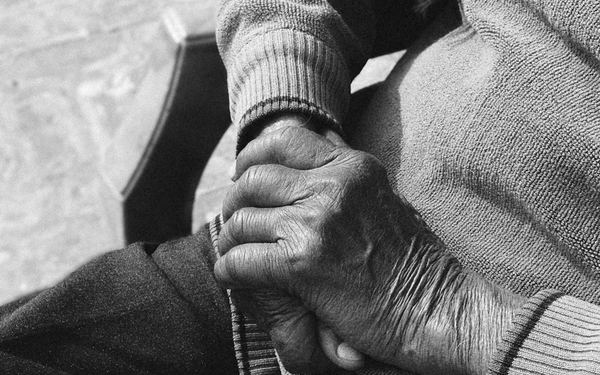
Watch your father cross his own living room. He does not walk across it so much as travel along it: a hand on the kitchen counter, then the back of the dining chair, then the arm of the sofa, then the door frame into the hall. Each handhold is spaced about one step apart. He has built himself a railing out of furniture, and he does not know he is doing it.
The cane is by the front door. It comes out for the doctor's office, for church, for the parking lot at the pharmacy. Out in public, where people are watching, he uses it. At home, where nobody is watching and where he spends almost every hour of his day, it leans against the wall.
Physical therapists have a name for what he is doing — furniture walking — and they notice it on the first visit, because it tells them two things at once. He knows he is unsteady. And whatever he has been given to fix that is not working for him.
Why this matters more at home than anywhere else
The CDC reports that more than one in four adults 65 and older falls each year, and that falls are the leading cause of injury for that age group. The fall that changes everything rarely happens in the pharmacy parking lot. It happens on the ordinary route between the bedroom and the bathroom, at the one spot in the hallway where there is nothing to grab.
That is the problem with furniture walking. It works until the path has a gap in it — a doorway, an open stretch of floor, a chair someone moved to vacuum and put back six inches to the left. It works in daylight and fails at 2 a.m., half-awake, on the way to the toilet.
He already told you why he won't use it
Ask and you will hear some version of: I don't need it in the house. It gets in the way. I'm fine. What you usually will not hear is the reason underneath, which is that the cane makes him look old — to the neighbors, to the grandchildren, and to himself.
This is not stubbornness unique to your father. In a 2009 study in the Disability and Health Journal, researchers ran focus groups with 61 adults aged 65 and older — White, Black and Hispanic — about mobility aids. Across every group, people valued what a cane or walker could do for their independence. And across every group, the association with aging and decline made people reluctant to use one. Black and Hispanic participants raised concerns about being judged for using an aid, worried about unsafe secondhand equipment, and said they would prefer aids that looked good. Hispanic participants expressed a preference for help from another person over a device.
Two findings from that study are worth holding onto. First, participants across all groups said their physician influenced whether they used an aid. Second, how a device looks is a real factor, not a vain one. A father who refuses a gray hospital-issue walker may happily use a well-made cane he picked out himself.
Sometimes the device is the problem
There is a harder truth underneath this, and it is why simply insisting he use the thing is not enough. A walking aid that is the wrong type or the wrong height, or that nobody ever taught him to use, is not the safety net it looks like.
A 2009 study in the Journal of the American Geriatrics Society estimated that about 47,000 older adults a year were treated in U.S. emergency departments for fall injuries associated with walkers and canes. Roughly seven in eight of those involved walkers, and about a third of the injured were admitted to the hospital. The researchers could not say exactly what caused each fall, and they called for more research into how these devices are designed and used. But the number is a useful corrective to the idea that a walking aid is safe just because it is in the house.
Think about where the one in your father's house came from. In a lot of families, the answer is: it was his late wife's walker, or a cane a neighbor left in the garage, or one that was bought at a drugstore in a hurry after a hospital discharge and never adjusted. Each of those was sized for someone else, or for no one at all. A cane that is too tall pushes the shoulder up and makes it awkward to lean on. A cane that is too short makes him stoop. Either one makes "it gets in the way" a fair description rather than an excuse.
What actually helps
You do not have to win the argument about whether he needs a cane. You need to change the conditions so that using one makes sense to him.
- Ask where, not whether. Skip "you need to use your cane." Ask instead: "Where in the house do you feel least steady?" He will usually tell you — the step down into the den, the bathroom at night, getting up from the recliner. That answer is the real problem list.
- Get the device fitted by someone qualified. Ask his doctor for a physical therapy evaluation. A physical therapist can check whether he needs a cane or a walker (and which kind), set it to the right height, and teach him how to use it on stairs and turns. Medicare Part B covers outpatient physical therapy when it is medically necessary. It also covers canes and walkers as durable medical equipment when a doctor orders them for use at home; you generally pay 20% of the Medicare-approved amount after the Part B deductible, from a Medicare-enrolled supplier.
- Let the doctor say it. The research above found that older adults across groups listen to their physicians on this. If the same sentence has failed coming from you ten times, it may land once from his doctor. Mention the furniture walking at the next appointment, specifically.
- Let him choose one he would be seen with. Canes come in wood, carbon, folding and offset-handle designs. Rollators come in colors other than surgical gray. If a better-looking device is the difference between the closet and his hand, that is money well spent.
- Read the route he has already built. The chain of furniture he leans on is a map of where he needs support. That is where grab bars, a sturdier chair, better lighting, or a clear path belong. A cane for the house and a separate one kept by the bed can also take away the problem of it always being in the wrong room.
- Watch the night trip. The walk to the bathroom after dark is where furniture walking fails first. Lighting along that path, and a device within reach of the bed, matter more than anything done in daylight.
Where another person fits in
For many older adults, the preference that study heard from Hispanic participants — a person rather than a device — is exactly right, and it does not have to be either/or. A caregiver in the home notices that the cane has migrated back to the front door and brings it back. They walk alongside on the trip to the shower, keep the path clear, and see the first time he reaches for a chair back that isn't there. They tell the family when something changes, before it turns into an emergency room visit.
That is the kind of non-medical daily support CarePali provides across the Westside and coastal Ventura County. If your parent is coming home after a procedure, our post-surgery care page explains what the first weeks can look like, and our services page lists what daily care includes.
One thing to do this week
Falls Prevention Awareness Week comes around every September, promoted by the National Council on Aging. You do not need to wait for it. Spend ten minutes at your parent's house watching how they get from the bedroom to the kitchen, and count the handholds. If there are more than two, that is not a quirk. It is the most honest assessment of their balance you are going to get, and it is worth bringing to their doctor.
Sources: the CDC publishes older adult fall data and its STEADI resources for families and clinicians. The walking-aid injury estimates are from Stevens et al., Journal of the American Geriatrics Society, 2009. The focus-group findings on attitudes toward mobility aids are from Resnik et al., Disability and Health Journal, 2009. Medicare's coverage of canes, walkers and durable medical equipment is explained on medicare.gov. None of this replaces an evaluation by your parent's own clinician or physical therapist.
If you are trying to figure out what daily help would look like in your parent's home, we can walk you through it. Call (310) 818-3217, email reach@carepali.com, or start care here.